

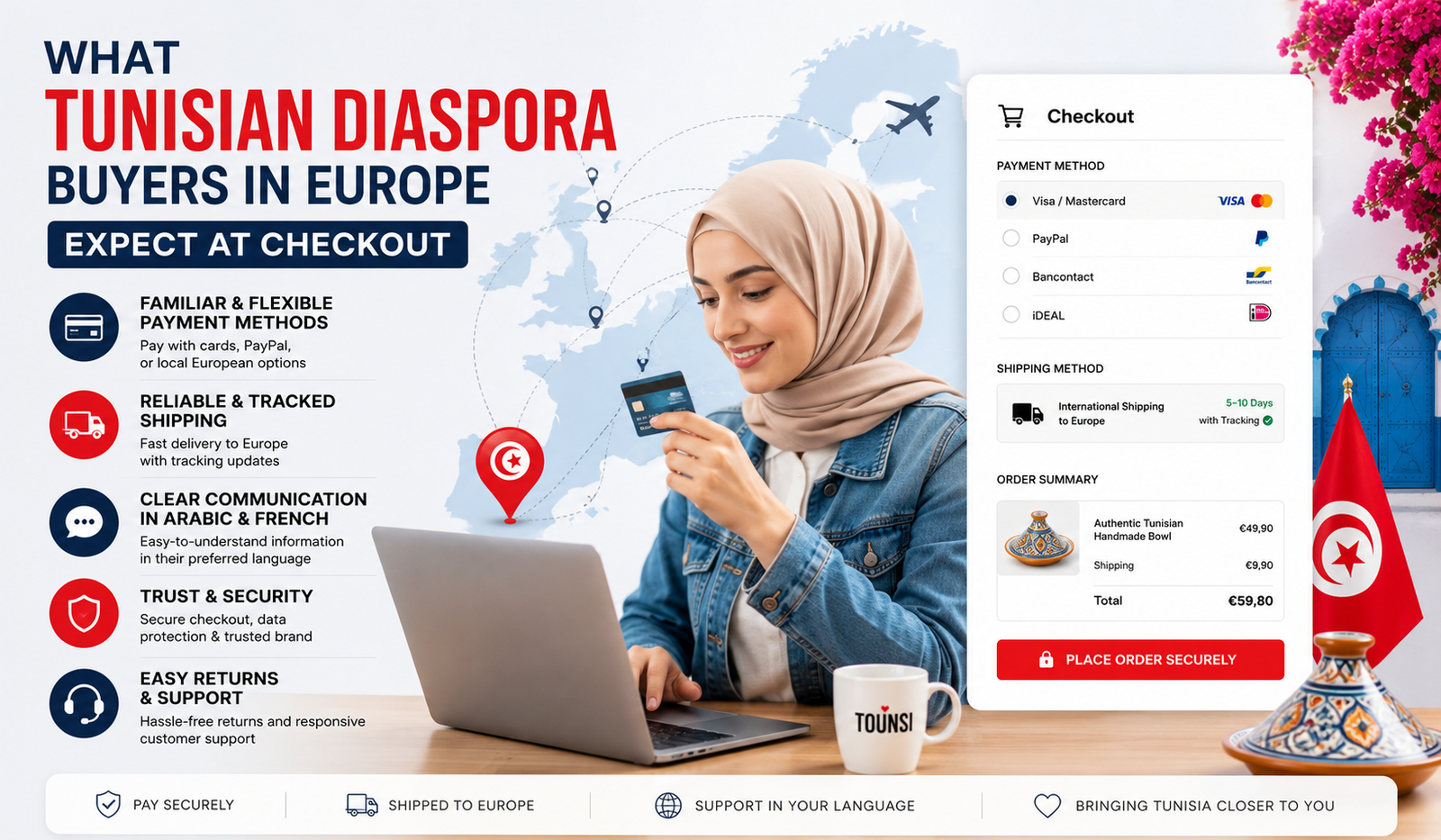
The Tunisian diaspora in Europe is a large and connected market. Families in France, Italy, and Germany buy from Tunisian brands for food, fashion, cosmetics, and gifts, often to stay close to home.
For a Tunisian online store, these buyers are a natural growth opportunity. But selling to them is not the same as selling at home. A diaspora shopper in Paris or Milan pays like a European, not like a buyer in Tunis. This guide explains what that means at checkout, market by market.
Table of Contents
• Who the Diaspora Buyers Are
• Why Diaspora Checkout Is Different
• What Buyers in France Expect
• What Buyers in Italy Expect
• What Buyers in Germany Expect
• The Common Threads
• Building a Checkout for Home and Diaspora
• Common Mistakes to Avoid
• FAQs
1. Who the Diaspora Buyers Are
France is home to the largest Tunisian community in Europe, with significant populations in Italy and Germany. Many are second or third generation, comfortable shopping online and keen to buy from home.
These buyers have money to spend and a reason to seek out Tunisian products. What they do not have is patience for a checkout that feels foreign or broken.
They live in the euro zone. Their cards, wallets, and habits are European. A store that understands this converts; one that does not loses them at the payment step.
Occasions drive much of this spending. Ramadan, Eid, weddings, and gifts sent to family create predictable spikes in demand for Tunisian products. A store ready for those moments reaches buyers a generic retailer never will.
2. Why Diaspora Checkout Is Different
A domestic Tunisian checkout is built around the dinar, local cards, wallets like Flouci, and cash on delivery. That setup is right for buyers inside Tunisia.
It is the wrong setup for a buyer in Lyon or Turin. They expect to pay in euros, with the methods common in their country, and to have their card accepted without friction.
There is a deeper constraint too. Because global processors like Stripe and PayPal are restricted for Tunisian-registered businesses, and currency controls limit how funds move, accepting euro payments is not as simple as flipping a switch. The same limits explain why Shopify Payments is not available in Tunisia.
So the gap is both currency and capability. Meeting diaspora expectations usually means running a second, Europe-facing payment setup alongside the local one.
It helps to remember the benchmark. Diaspora buyers compare your checkout to Amazon and the European stores they use daily. Measured against that bar, a clumsy or foreign-feeling payment step reads as a reason to leave.
3. What Buyers in France Expect
France runs on Cartes Bancaires, the domestic card network that sits behind most French cards. Accepting it is the baseline, not a nice-to-have.
PayPal is the strong second choice, used by more than half of French online shoppers. Offering it signals trust and captures buyers who avoid entering card details.
Add Visa and Mastercard for international cards, and you cover most French buyers. Prices should show in euros from the first page, not convert only at the end.
French shoppers also expect clear delivery times and an easy returns policy, so pair the payment options with transparent shipping information at checkout.
4. What Buyers in Italy Expect
Italian shoppers lean on cards. Credit and debit cards together are the preferred online method, often co-badged with Visa or Mastercard for international use.
PayPal is popular in Italy as well, and digital wallets are growing quickly. A checkout with cards plus PayPal covers the large majority of Italian diaspora buyers.
Italians also value clear pricing and a smooth mobile checkout. Many shop from their phones, so the euro-denominated mobile experience has to be clean and fast.
Cash on delivery has a long history in Italy, but for cross-border orders shipped from Tunisia, card and PayPal are the realistic options a diaspora buyer will actually use.
5. What Buyers in Germany Expect
Germany is the market most likely to trip up an unprepared store. Card-only checkout performs poorly here, which surprises many first-time sellers.
PayPal is dominant, used by around seventy percent of German online shoppers. For this market it is close to essential.
Germans also expect to pay after the goods arrive. Invoice and buy-now-pay-later options, along with SEPA bank transfer and direct debit, reflect a deep preference for bank-based payment.
A store selling to the German diaspora should lead with PayPal, offer a bank-based or invoice option where possible, and treat cards as secondary rather than primary.
German consumers value security and control. A checkout that offers a familiar, bank-based way to pay signals that the store is legitimate, which matters for a brand they may not know yet.
6. The Common Threads
Across all three markets, a few expectations hold:
• Pay in euros: prices should be shown and charged in EUR, not converted awkwardly at the end.
• PayPal matters: it is trusted region-wide and often the deciding factor for a hesitant buyer.
• Cards must work: Visa and Mastercard cover the international tail in every market.
• A local method per country: Cartes Bancaires in France, strong card and wallet support in Italy, bank-based and invoice options in Germany.
The lesson is simple: there is no single European checkout. Each market has a method you cannot skip, and PayPal plus cards is the shared floor, not the whole answer.
For stores mapping accepting euro and dinar payments, this is where a flexible setup earns its value.
7. Building a Checkout for Home and Diaspora
The real challenge is running two payment worlds at once: the dinar and local methods for Tunisia, euros and European methods for the diaspora.
On Shopify, this usually means combining multi-currency support with a payment setup that can present the right methods to the right buyer.
In practice, that means showing euro prices to European visitors and dinar prices to local ones, then routing each payment to a provider that can settle it. Done well, the buyer never notices the machinery behind the choice.
Managing that many providers separately is heavy work. A payment mediation platform connects a store to local and international options through one integration, so you can serve both audiences without wiring up each provider by hand.
Platforms such as UnumPay take this approach for Shopify stores. For merchants weighing their checkout options for Tunisian buyers at home and abroad, it keeps the setup manageable rather than fragmented.
The payoff is reached without chaos: one store and one back office, with two audiences each served in the currency and methods they expect.
8. Common Mistakes to Avoid
A few missteps cost diaspora sales again and again:
• Charging in dinars only: a euro-zone buyer should not have to think about exchange rates.
• Card-only checkout: it underperforms across Europe, and badly in Germany.
• Ignoring PayPal: skipping it removes the method many buyers trust most.
• One-size-fits-all: treating France, Italy, and Germany as a single market misses what each expects.
Each mistake sends the same message to the buyer: this store was not built for me. The fix is to meet them in their market, currency, and preferred method, the same care you would give Tunisia ecommerce payment options at home.
FAQs
Do diaspora buyers want to pay in dinars or euros? Euros. They live in the euro zone and expect prices and payment in their local currency.
Is PayPal necessary for selling to the Tunisian diaspora? Close to it. PayPal is trusted across France, Italy, and Germany and often decides a hesitant sale.
What is the biggest difference between the three markets? Germany, where card-only checkout fails and invoice or bank-based payment is expected.
Can a Tunisian store serve both local and diaspora buyers? Yes, by running a euro, Europe-facing setup alongside the local dinar setup.
Do I need different providers for European payments? Usually additional methods, which are easiest to manage through a single integration rather than many.
The Bottom Line
The Tunisian diaspora in France, Italy, and Germany is ready to buy from home, but only if the checkout speaks their language.
If the full setup feels like a lot, start with euros, cards, and PayPal. That combination alone covers most diaspora buyers across the three markets, and the country-specific methods can follow as volume grows.
That means euros, PayPal, working cards, and the one local method each market expects. Get those right and the distance between Tunis and Paris disappears at the payment step.
Serve the diaspora the way they already pay, and a Tunisian brand turns a scattered community into a reliable second market.